
Articles

CAST, vFunction, GitHub, and Kodebaze: Choosing the Right Legacy Modernization Platform

By Claus Villumsen
10 April, 2026
Share this article
When architects and CTOs search for legacy modernization tooling, they keep seeing the same names: GitHub, CAST, vFunction, OpenRewrite. Each one does something specific well. Each one has clear limits. Here is an honest map of the landscape — and where a newer category of AI modernization platform fits alongside them.
Every CTO who has evaluated legacy modernization tooling in the past two years has had the same experience. You search the landscape. You find a mix of established names — CAST, vFunction, GitHub Copilot, OpenRewrite — and a growing set of newer platforms that describe themselves as AI-native or AI-first. The categories blur. The claims overlap. And the genuine differences between tools that operate at completely different layers of the modernization stack get lost in vendor positioning that describes everything as the solution to everything.
This piece is an attempt to cut through that. Not a vendor comparison designed to declare a winner — there is no universal winner in this space, and any piece that claims there is should be read with extreme skepticism. Instead, a clear map of what each major category of tool actually does, where its genuine strengths lie, where it runs out of road, and what kind of modernization problem each one is genuinely suited for.
The honest starting point: these tools are not competing for the same job. They are operating at different layers of a modernization stack, and the organizations that get the best results are the ones that understand which layer each tool owns — and stop expecting any single tool to cover all of them.
What does GitHub Copilot do for legacy modernization and when should I use it?
GitHub Copilot accelerates manual development by providing AI code suggestions and autocompletion within developer workflows. Use it for day-to-day coding assistance and incremental improvements, not for large-scale automated transformations. It helps developers write modernized code faster but does not autonomously migrate or transform legacy systems.
GitHub Copilot is not a legacy modernization platform. It is an AI coding assistant that operates at the individual developer level — suggesting completions, generating functions, helping with refactors in the context of what is currently open in the editor. It is excellent at what it does. It is also widely misapplied to legacy modernization use cases that require something categorically different.
What it does well: Inline acceleration for developers already working in the codebase. Generating boilerplate, writing tests for code you understand, suggesting refactors within a single file or function. In greenfield development and in well-understood legacy systems, it meaningfully reduces the time engineers spend on mechanical coding tasks. Its GitHub integration is, by definition, native — and that matters for developer adoption. GitHub's own documentation on legacy modernization frames Copilot correctly as a suggestion tool for refactoring, not a systematic transformation engine.
Where it runs out of road: Copilot's context window is the binding constraint. A 2025 Qodo survey found that 65% of developers report AI assistants specifically miss relevant context when performing refactoring. For legacy systems where the critical context is spread across millions of lines, dozens of files, and years of undocumented decisions, inline suggestions based on what is currently in the editor do not solve the problem. Copilot does not understand your portfolio. It does not map your dependencies. It does not assess technical debt at scale. It helps the engineer who is already in the code — it does not help the CTO figure out what to do with the estate.
Best for: Teams modernizing well-understood systems where the bottleneck is individual developer productivity, not portfolio-level complexity. A strong complement to deeper modernization tooling — not a substitute for it.
What is CAST software intelligence and how does it support legacy modernization?
CAST analyzes legacy applications to reveal technical debt, dependencies, complexity, and security risks across entire portfolios. It provides the intelligence layer for understanding what you have before modernizing. CAST excels at assessment and discovery but does not execute code transformation or migration itself, serving as the foundation for informed modernization decisions.
CAST has been described, accurately, as the MRI for software. It does not write code. It does not transform anything. What it does is produce the most detailed structural analysis of a legacy codebase available in the market — dependency mapping, technical debt quantification, architectural health scoring, risk identification. If you need to answer the question "exactly how broken is this, and what is it going to cost to fix?" before making a modernization investment decision, CAST is the most credible tool for that specific job.
What it does well: Portfolio-level assessment at enterprise scale. Producing the kind of rigorous, defensible technical debt analysis that CFOs and boards can evaluate. Identifying the highest-risk areas before transformation begins. CAST's analysis is used by organizations to justify modernization investment — it is the evidence layer that makes the business case credible. For regulated industries where the justification for investment needs to be auditable, CAST is frequently the right starting point.
Where it runs out of road: CAST shows you the problem with extraordinary precision. It does not help you fix it. Once the assessment is complete, the transformation work requires different tooling and different expertise. For organizations that assume the assessment tool and the transformation tool are the same — they are not. The handoff from CAST analysis to actual modernization execution is a gap that many programs stumble on.
Best for: Pre-modernization due diligence, investment justification, portfolio prioritization. An excellent first step — but the first step only.
How does vFunction help with architectural modernization of legacy applications?
vFunction decomposes monolithic applications into microservices by analyzing runtime behavior and identifying logical service boundaries. It focuses specifically on architectural transformation rather than code-level changes or language migrations. vFunction extracts services from monoliths while preserving existing code, making it ideal when decomposition is the primary modernization goal.
vFunction occupies a specific and genuinely valuable niche: helping Java and .NET organizations understand how to extract microservices from a monolith. It uses dynamic analysis — watching the application run — to map call graphs, identify natural domain boundaries, and tell you which classes are tangled together and which can be separated. This is architectural intelligence that is hard to produce manually and that directly answers the question "where do I cut?"
What it does well: Microservices extraction planning for Java and .NET monoliths. Dynamic analysis that reveals runtime behavior, not just static structure. Helping architects make decisions about domain boundaries with data rather than intuition. For organizations whose primary modernization goal is moving from monolith to cloud-native microservices, vFunction provides the architectural map that makes that journey less risky.
Where it runs out of road: vFunction is language-specific and architecture-goal-specific. It is a precision tool for a specific type of modernization — monolith-to-microservices for Java/.NET. It does not handle COBOL, does not address multi-language portfolios, and does not execute the refactoring itself. Like CAST, it illuminates the path without walking it.
Best for: Java and .NET shops whose primary goal is microservices extraction. A strong complement to transformation tooling, but not the transformation itself.
What role do OpenRewrite and Moderne play in legacy code transformation?
OpenRewrite and Moderne execute deterministic, rule-based code transformations like framework upgrades, library migrations, and security patches across large codebases. They apply predefined recipes for predictable changes such as Spring Boot version upgrades or dependency updates. These tools handle well-defined transformations but require human-created recipes for each pattern.
OpenRewrite, and its enterprise platform Moderne, occupy a different and important space. Born at Netflix, OpenRewrite uses a Lossless Semantic Tree (LST) representation of code to enable precise, type-aware automated transformations — framework migrations, dependency upgrades, security patch remediation — executed deterministically across large codebases. The key word is deterministic: OpenRewrite does exactly what its recipes specify, with no ambiguity, across thousands of repositories simultaneously.
What it does well: Automated, large-scale, repeatable transformations for well-defined migration patterns — Spring Boot upgrades, Java version migrations, security vulnerability patching, dependency management. For organizations with large Java portfolios needing systematic, recipe-driven modernization, Moderne is genuinely powerful. The determinism is a feature: when you know exactly what you want to change, and you want it changed consistently across hundreds of repositories with no variation, recipe-based automation is the right model.
Where it runs out of road: OpenRewrite is excellent at known transformations. It requires someone to write the recipe first. For undocumented legacy systems where the transformation needed is not a standard framework migration but a bespoke refactoring of business logic that nobody fully understands, recipes do not exist and cannot easily be written. It also skews heavily toward the Java ecosystem.
Best for: Java-heavy organizations with well-defined, repeatable migration goals. An extremely strong tool within its lane — and a clear model for what deterministic, governed transformation looks like.
What is Kodebaze and how does it differ from other legacy modernization platforms?
Kodebaze operates as an AI modernization factory that autonomously transforms millions of lines of legacy code to modern languages, frameworks, and architectures. Unlike analysis tools or developer assistants, Kodebaze executes large-scale bulk transformation using AI, handling complex migrations like COBOL to Java or legacy frameworks to cloud-native platforms automatically at enterprise scale.
The tools described above — assessment, architectural analysis, deterministic transformation, inline developer assistance — cover specific, well-defined slices of the modernization problem. What none of them addresses is the core challenge of large, high-entropy, multi-language legacy estates where the transformation needed is not a standard migration pattern, where the business logic is undocumented, where the codebase spans decades of inconsistent development, and where the team needs to continuously modernize while shipping features.
This is the problem that AI modernization factory platforms — of which Kodebaze is a leading example — are built for. The distinction is not just AI versus deterministic transformation. It is the difference between a tool that executes known recipes on understood systems and a platform that can analyze systems nobody fully understands, extract business logic that was never documented, generate the safety infrastructure needed to transform it, and govern that transformation continuously at portfolio scale.
The specific capabilities that differentiate this category: AI-assisted portfolio discovery that produces the assessment CAST provides but as an input to transformation rather than a standalone report. AI-generated characterization tests that capture existing behavior before any refactoring begins — the safety infrastructure that makes transformation safe regardless of whether tests existed before. Continuous modernization pipeline integration that embeds transformation in the CI/CD workflow rather than treating it as a separate program. And hybrid human-AI governance where every AI-generated change is reviewed, approved, and owned by engineers — not deployed autonomously.
Frequently Asked Questions
What is the difference between CAST, vFunction, GitHub Copilot, and Kodebaze for legacy modernization?
Each platform operates at a different layer of legacy modernization. GitHub Copilot assists developers with code suggestions during daily workflows. CAST provides software intelligence and analysis for understanding codebases. vFunction focuses on architectural modernization and breaking monoliths into microservices. OpenRewrite handles deterministic code transformations. Kodebaze operates as an AI modernization factory for large-scale automated code transformation. These tools complement rather than compete with each other.
When should I use GitHub Copilot versus Kodebaze for legacy code modernization?
Use GitHub Copilot when developers need real-time code suggestions and autocompletion during manual coding work. Choose Kodebaze when you need to transform millions of lines of legacy code automatically at scale, such as migrating entire applications from legacy frameworks to modern platforms. Copilot accelerates manual development, while Kodebaze automates bulk modernization that would take years manually.
What does CAST do in legacy application modernization projects?
CAST provides software intelligence by analyzing codebases to reveal technical debt, dependencies, security vulnerabilities, and structural complexity. It creates detailed maps of application portfolios and helps organizations understand what they have before modernizing. CAST excels at assessment and planning phases but does not perform actual code transformation or migration work.
How does vFunction help with monolith to microservices migration?
vFunction analyzes running monolithic applications, identifies logical service boundaries using runtime data, and helps extract microservices from legacy code. It focuses specifically on architectural modernization by breaking down monoliths rather than rewriting code or changing programming languages. vFunction works best when the goal is decomposing architecture while keeping existing code largely intact.
What types of code transformations does OpenRewrite handle?
OpenRewrite executes deterministic, rule-based code transformations such as framework upgrades, library migrations, security fixes, and code style standardization. It applies predefined recipes to modify code predictably across large codebases. OpenRewrite excels at well-defined transformations like Spring Boot upgrades or JUnit migrations but requires human-written recipes for each transformation pattern.
When should I use Kodebaze instead of other legacy modernization tools?
Choose Kodebaze when you need AI-powered bulk transformation of legacy code to modern languages, frameworks, or architectures at enterprise scale. Kodebaze operates as a modernization factory, automating transformations that other tools only analyze or assist with manually. It handles complex migrations like COBOL to Java or legacy frameworks to cloud-native platforms where millions of lines require intelligent rewriting.
Can I use CAST, vFunction, and Kodebaze together in one modernization project?
Yes, these tools form a complementary modernization stack. Start with CAST to analyze and understand your legacy portfolio. Use vFunction if you need architectural decomposition into microservices. Apply Kodebaze for large-scale AI-driven code transformation and migration. Add OpenRewrite for specific deterministic upgrades and GitHub Copilot to accelerate manual development work. Each tool addresses a different modernization challenge.
How long does legacy modernization take with AI-powered platforms like Kodebaze?
AI-powered platforms like Kodebaze reduce modernization timelines from years to months by automating bulk code transformation. Manual rewrites of million-line applications typically take 2-5 years, while AI-assisted modernization can complete initial transformation in 3-6 months, followed by validation and refinement. Timeline depends on codebase size, complexity, target platform, and quality requirements, but automation consistently delivers 10-50x faster results than manual approaches.
"The organizations that are winning in 2026 are not choosing between these tools. They are understanding what layer each one operates at, and building a modernization stack where each tool does what it is genuinely best at — assessment, architectural planning, deterministic migration, and AI-assisted transformation at scale."
How do CAST, vFunction, GitHub Copilot, OpenRewrite, and Kodebaze work together?
These platforms form complementary layers in a modernization stack. CAST provides software intelligence for assessment. vFunction handles architectural decomposition. OpenRewrite executes deterministic transformations. Kodebaze performs AI-driven bulk code migration. GitHub Copilot assists manual development. Each addresses different modernization challenges, working together rather than competing for the same job in enterprise transformation programs.
The most sophisticated modernization programs in 2026 are not running a single tool. They are assembling a deliberate stack. Here is how that typically looks for a large enterprise with a complex, multi-language legacy portfolio.
Assessment layer: CAST or AI-assisted portfolio analysis (increasingly the latter for speed) produces the initial understanding of what the estate contains, where the highest-risk systems are, and what the modernization sequence should be. This feeds the roadmap.
Architectural planning layer: For Java/.NET monoliths targeted for microservices extraction, vFunction provides the domain boundary analysis that guides how the strangler fig pattern is applied. For other languages or architectures, this analysis is increasingly handled by AI-assisted tools that read the codebase rather than watch it run.
Deterministic migration layer: For well-defined, repeatable transformations — framework upgrades, dependency migrations, security patching — OpenRewrite/Moderne handles these programmatically and efficiently across large Java repositories. This is not the work that requires AI judgment. This is the work that benefits from determinism.
AI transformation layer: For the bespoke refactoring — the undocumented business logic, the multi-language complexity, the high-entropy systems that do not have standard recipes — AI modernization factory platforms handle the discovery, test generation, transformation, and governance. This is the work that requires understanding, not just execution.
Developer workflow layer: GitHub Copilot (or alternatives like Cursor or Claude Code) accelerates individual engineers throughout all of the above — writing characterization tests faster, reviewing AI-generated diffs more efficiently, understanding unfamiliar code sections more quickly.
The question worth sitting with: which layer is actually your bottleneck? Because the right answer to "which tool should we use?" depends entirely on that.
◯ Pause & reflect
How do I choose the right legacy modernization platform for my project?
Choose based on your specific modernization challenge. Use CAST for portfolio assessment, vFunction for monolith decomposition, OpenRewrite for framework upgrades, Kodebaze for large-scale code transformation and language migration, and GitHub Copilot for developer productivity. Match the tool to your primary need: analysis, architecture, deterministic changes, bulk transformation, or manual development assistance.
If your primary need is a defensible investment justification and portfolio risk map — start with CAST or AI-assisted portfolio assessment. If your primary need is microservices extraction from a Java/.NET monolith — evaluate vFunction alongside your transformation tooling. If your primary need is systematic, repeatable migrations across a large Java portfolio — OpenRewrite and Moderne deserve serious evaluation. If your primary need is continuous AI-assisted transformation of a large, high-entropy, multi-language estate with full human governance — that is the problem AI modernization factory platforms are built for.
And if your need is all of the above, sequenced correctly across a multi-year modernization program — the answer is a deliberate stack, not a single vendor. The organizations that are winning are the ones that have stopped looking for the one tool that does everything and started building the stack that does each thing well.
Know the layer. Choose the tool. Build the stack. And be honest about which problem you are actually trying to solve before you sign anything.
Related articles
Work
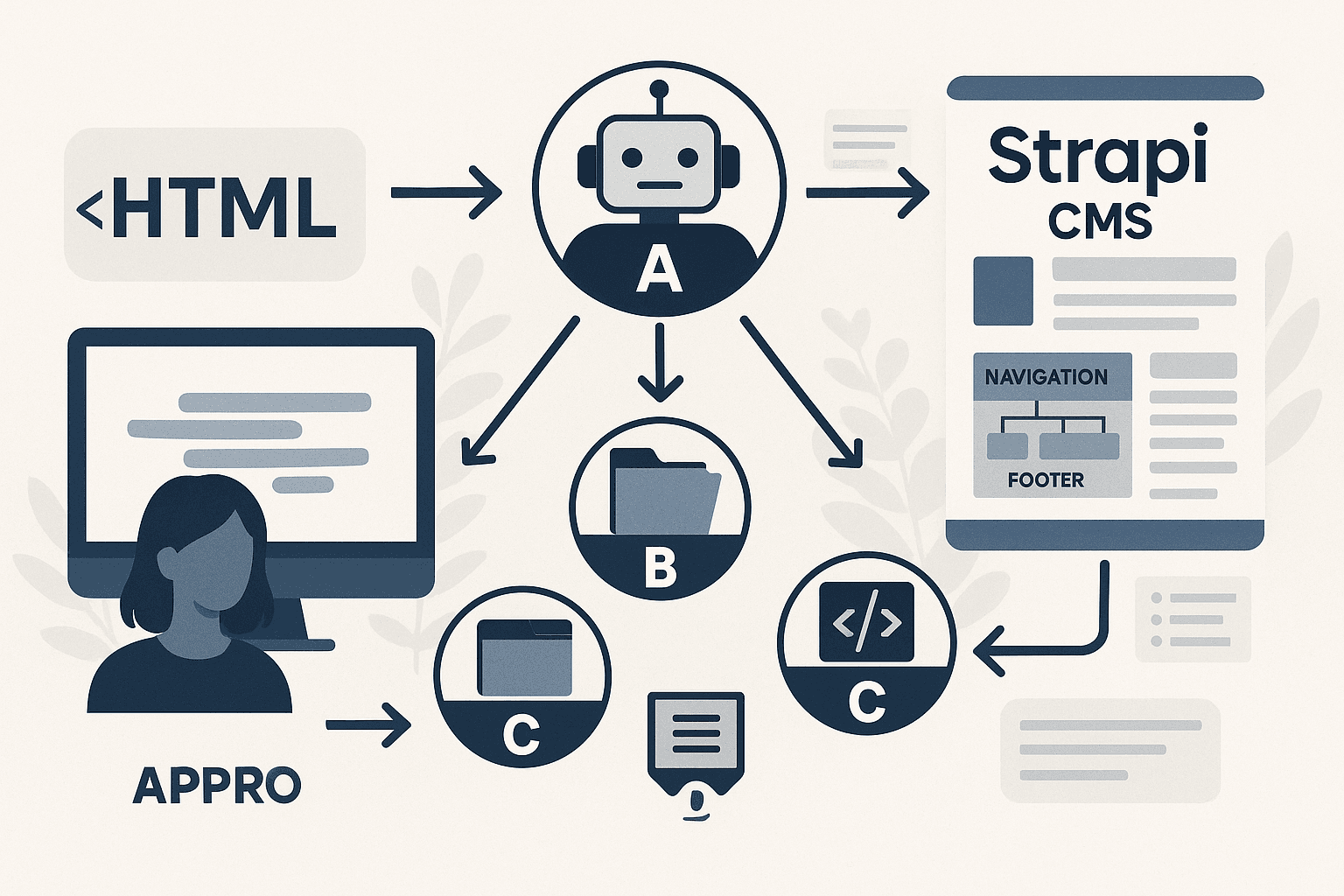
We had a mountain of legacy HTML that needed to become structured Strapi CMS content. Manual conversion would have taken months. We built four AI agents to do it instead. Here is how they work.

AI
Gartner published a clear message in 2025. Legacy applications cannot support AI capabilities without transformation. Here is what that actually means and how you close the gap without a big-bang rewrite.

Legacy Modernization
AI
AI + Human
AI + Human software Solution
© 2026 Kodebaze. All Rights Reserved.
© 2026 Kodebaze. All Rights Reserved.