
Articles

Digital Transformation Stalls When Legacy Systems Cannot Keep Up. Here Is the Fix.

By Claus Villumsen
21 March, 2024
Share this article
Every digital transformation strategy eventually hits the same wall. The legacy system that cannot be modernized fast enough. Here is why that wall exists and what it actually takes to get through it.
Digital transformation is one of those phrases that means everything and nothing at the same time. Ask ten executives what it means and you will get ten different answers. Faster customer experiences. AI-powered products. Cloud infrastructure. Data-driven decisions. All of these are correct. None of them is complete.
The thing they all have in common is that none of them is possible without the infrastructure to support it. And for most large organizations, that infrastructure is the problem.
What is the hidden constraint in every digital transformation strategy?
The hidden constraint is the legacy system that cannot be modernized fast enough to support new digital initiatives. While organizations focus on strategy, culture, and customer experience, the outdated technical infrastructure becomes the bottleneck that determines actual transformation speed regardless of budget or executive commitment.
Most digital transformation strategies are written as if the organization starts from a clean slate. New capabilities, new platforms, new ways of working. The roadmap looks compelling. The business case is solid. The board approves it.
Then someone asks how the new capabilities will connect to the existing systems. The ERP that has been running since 2003. The customer database that was built on a platform no longer supported by its vendor. The transaction processing system that nobody fully understands but that runs every day without fail.
This is where most transformations slow down. Not because the new technology is wrong. Because the legacy systems that hold the business's data, processes, and accumulated logic cannot expose what the new systems need. Cannot integrate in the ways modern platforms expect. Cannot be changed quickly enough to keep pace with the transformation around them.
The legacy system is not the enemy of digital transformation. It is the hidden constraint that determines how fast transformation can actually move.
Why do legacy systems resist change?
Legacy systems resist change because they were built with different technologies, architecture patterns, and business requirements than exist today. Accumulated technical debt, missing documentation, complex interdependencies, and risk of breaking revenue-generating processes make any modification slow, expensive, and potentially dangerous to business continuity.
Legacy systems resist change for a specific reason. They contain knowledge that exists nowhere else.
Decades of business rules, accumulated through real-world operation. Edge cases discovered through failure. Regulatory requirements encoded in ways nobody documented. Calculation logic that looks simple on the surface but depends on values set three layers up in a call stack that nobody has traced in years.
When you try to change a system like this quickly, you lose things. The new system does most of what the old one did. Most is not enough when the legacy system is running your core business processes.
This is why digital transformation timelines slip. Not because the transformation vision is wrong. Because the work of safely extracting and preserving the knowledge encoded in legacy systems is slow, careful work. It takes time to understand what you have before you can safely replace it.
What changes when you modernize the constraint?
When you modernize the constraining legacy system, digital transformation velocity increases exponentially. Development cycles shorten from months to days, integration becomes straightforward, new capabilities deploy rapidly, operational costs decrease, and the entire organization gains agility to respond to market opportunities without technical limitations blocking progress.
Organizations that successfully modernize their legacy estate do not just get faster systems. They get something more valuable. They get a business that can actually execute on its transformation strategy.
Modern APIs that expose data to new products and platforms. Clean separation between business logic and infrastructure, so that either can change without breaking the other. Architecture that can scale with demand rather than requiring planned downtime for maintenance. Systems that a new engineer can understand and contribute to in weeks rather than months.
These are not technical outcomes. They are business outcomes. The ability to ship new capabilities faster. The ability to respond to market changes without a six-month change request cycle. The ability to adopt AI tools that require clean, accessible data rather than data locked inside a system that cannot expose it.
Digital transformation succeeds when the infrastructure can support it. Getting the infrastructure right is not a precondition for starting. It is the work itself.
What approach actually works for legacy system modernization?
The approach that works is incremental constraint removal, not complete system replacement. Identify the specific bottleneck blocking transformation, isolate it through API boundaries, build modern alternatives for critical paths, migrate functionality gradually while maintaining business operations, and validate each step before proceeding to minimize risk.
The organizations that get through the legacy constraint fastest are not the ones that plan the most exhaustively before starting. They are the ones that understand enough to choose the right approach, then move carefully and incrementally.
Map the legacy system first. Understand every dependency, every hidden business rule, every module that other modules rely on in ways nobody documented. This work, which used to take months, now takes days with AI-assisted analysis.
Then move one piece at a time. Extract one capability, rebuild it with modern architecture, validate it against the legacy behavior, cut over. Keep the old system running alongside the new one until you are certain. Repeat.
This is not a fast approach on paper. It is the fastest approach in practice, because the risk at any point is small and manageable. And because it preserves the knowledge encoded in the legacy system rather than losing it in a big-bang rewrite.
Digital transformation is achievable. The legacy constraint is solvable. The path through it is incremental, governed, and safer than most organizations expect.
Frequently Asked Questions
Why do legacy systems slow down digital transformation?
Legacy systems slow down digital transformation because they lack modern APIs, use outdated technology stacks, contain undocumented dependencies, and cannot scale to handle new digital workloads. These systems become the bottleneck that limits how fast organizations can deploy new capabilities, forcing companies to either work around them or halt progress entirely.
What is a legacy system constraint in digital transformation?
A legacy system constraint is the technical bottleneck where outdated infrastructure prevents new digital initiatives from moving forward. It manifests as the point where modernization speed cannot match business demand, causing transformation projects to stall, budgets to overrun, and strategic goals to remain unmet despite investment in new technologies.
How do you modernize legacy systems without stopping business operations?
Modernize legacy systems by using a strangler fig pattern - gradually replacing old functionality with new services while maintaining business continuity. Build API layers over legacy code, migrate workloads incrementally, run old and new systems in parallel, and decouple critical functions one domain at a time rather than attempting risky big-bang replacements.
What happens when you remove legacy system bottlenecks?
When you remove legacy system bottlenecks, digital transformation accelerates dramatically. Teams can deploy new features in days instead of months, integration costs drop by 60-80%, system reliability improves, technical debt decreases, and the organization gains the flexibility to respond quickly to market changes and customer demands.
How long does legacy system modernization take?
Legacy system modernization typically takes 12-36 months depending on system complexity and business criticality. Using incremental approaches, organizations see initial results in 3-6 months. Complete replacement can take longer, but phased modernization delivers value continuously rather than requiring years of investment before any business benefit appears.
What is the difference between legacy modernization and digital transformation?
Legacy modernization updates outdated technology infrastructure and systems architecture. Digital transformation changes business models, customer experiences, and operating processes using technology. Modernization is the technical enabler that removes constraints, while transformation is the broader strategic change that modernization makes possible.
Why do legacy systems resist change?
Legacy systems resist change because they were built when business requirements, technology capabilities, and architectural patterns were fundamentally different. Decades of patches create complex dependencies, original developers have left, documentation is missing, and any modification risks breaking critical business functions that generate revenue.
What approach actually works for legacy system modernization?
The approach that works is targeted constraint removal rather than complete replacement. Identify the specific bottleneck blocking transformation, isolate that component, build modern alternatives for critical paths, establish API boundaries, migrate incrementally with rollback capability, and validate business continuity at each step before proceeding.
Kodebaze helps large organizations remove the legacy constraint from their digital transformation strategy. Full codebase analysis in days. Incremental modernization without stopping the business.
See how it works →Related articles

Work
Productivity
Legacy modernization requires different instincts than greenfield development. These are the eleven habits that separate engineers who succeed at it from those who struggle.


Legacy Modernization
AI
Productivity
AI
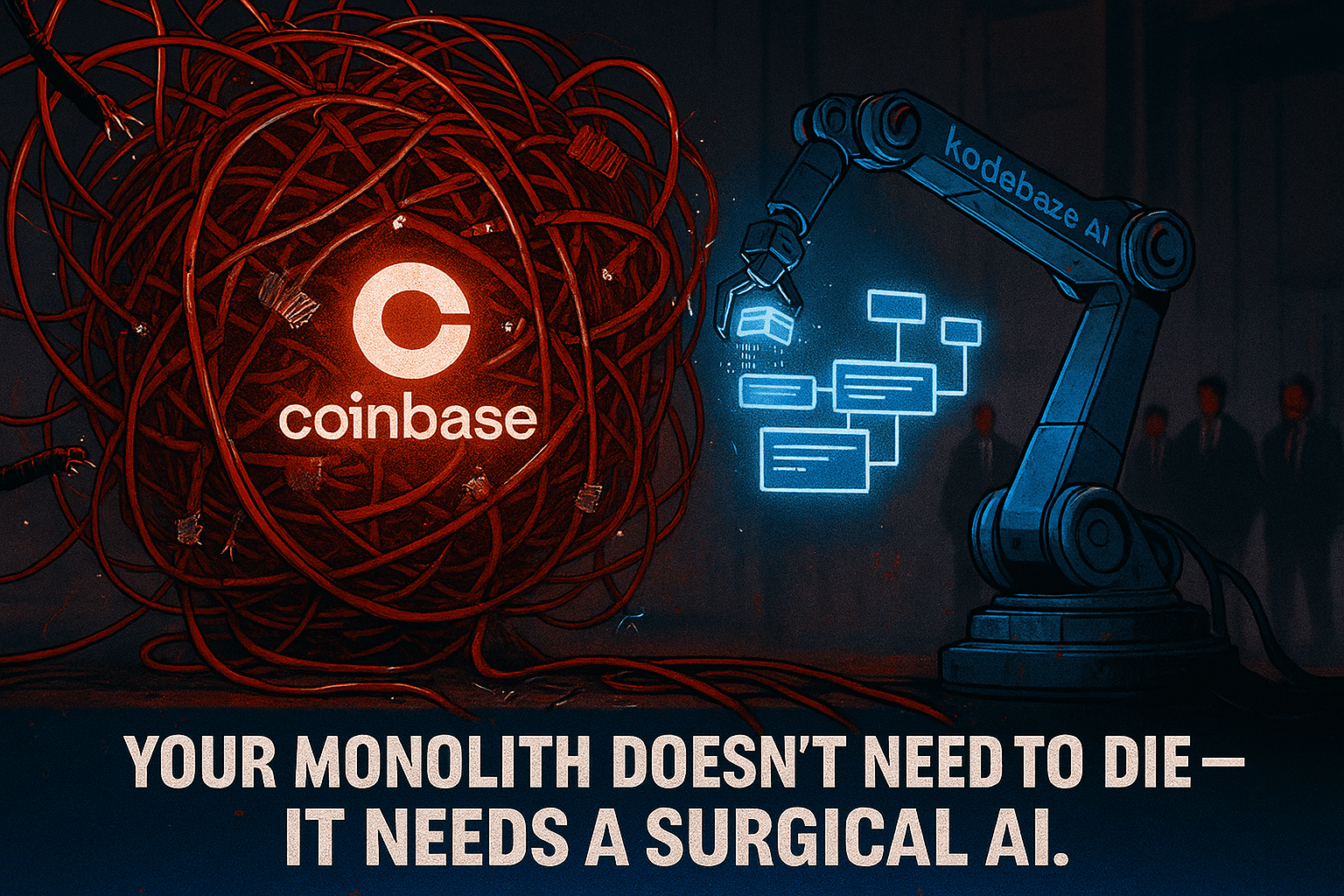
Coinbase built a Ruby on Rails monolith that scaled to billions in transactions and then became a liability. The technical debt they accumulated took years to address. Here is what the faster path looks like.
AI + Human
AI + Human software Solution
© 2026 Kodebaze. All Rights Reserved.
© 2026 Kodebaze. All Rights Reserved.