
Articles
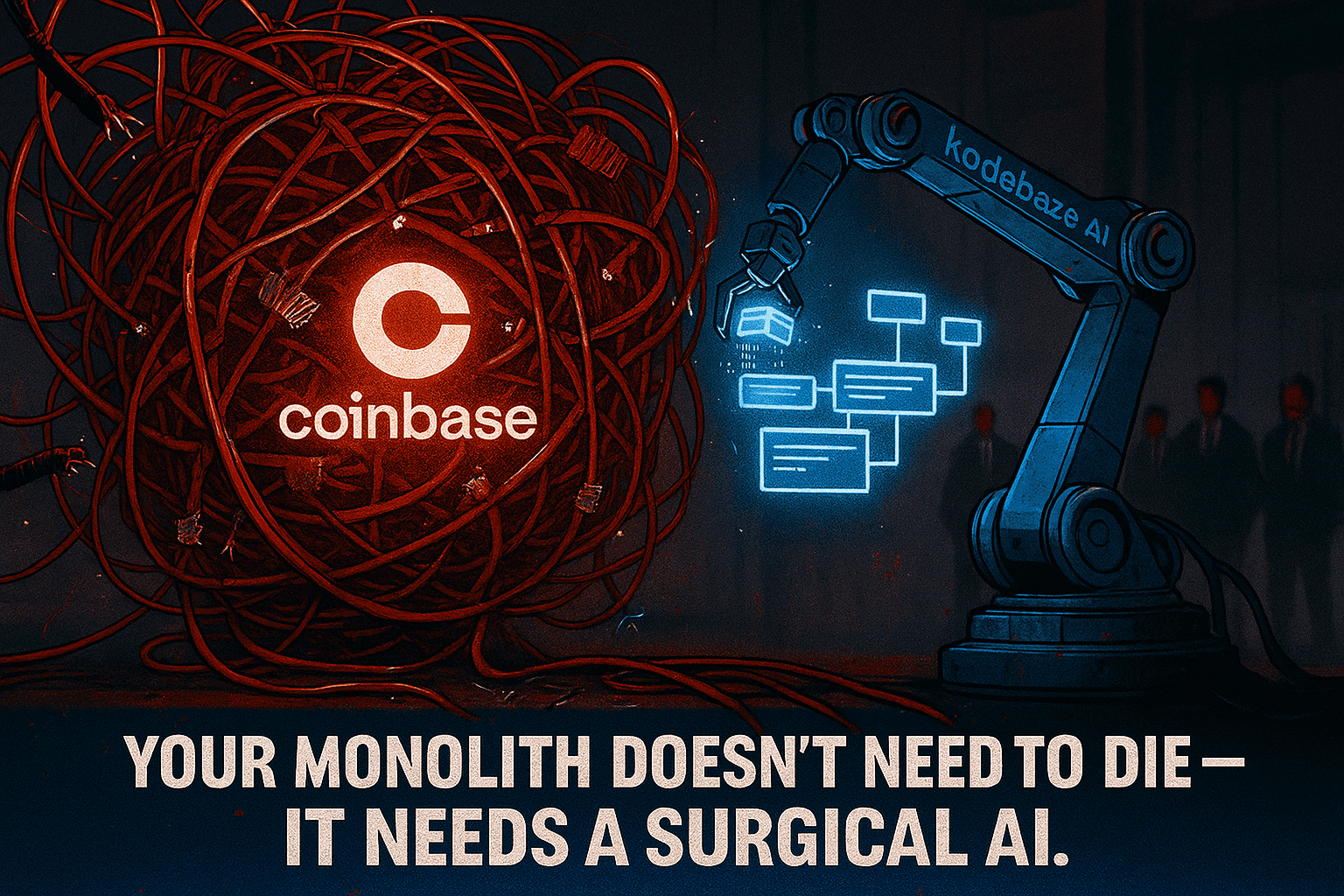
How Coinbase Could Have Avoided Years of Technical Debt

By Claus Villumsen
30 July, 2025
Share this article
Coinbase built a Ruby on Rails monolith that scaled to billions in transactions and then became a liability. The technical debt they accumulated took years to address. Here is what the faster path looks like.
In 2012, Coinbase had one goal. Make buying Bitcoin as easy as buying anything else online.
Ruby on Rails was the right choice for that goal. It was fast to build on, well understood by the team, and good enough for the scale they were operating at. Wallets, transactions, KYC, trading interfaces, customer support — all of it in one app, one repo, one team.
That worked. Until it didn't.
What happens when a monolithic application experiences hypergrowth?
A monolithic application under hypergrowth becomes increasingly fragile as traffic multiplies. Every deployment risks system-wide failures, database queries slow exponentially, and development velocity collapses. The single shared codebase cannot scale horizontally, forcing expensive vertical scaling while teams struggle to ship features safely, creating operational crisis and competitive disadvantage.
Coinbase grew faster than almost any financial technology company in history. Millions of users. Billions of dollars in transactions. Regulatory requirements across dozens of jurisdictions. New products — Coinbase Pro, Coinbase Commerce, institutional custody — each one needing to be built on top of infrastructure designed for a much simpler use case.
The Rails monolith started showing the familiar signs. Build times measured in minutes. Deployments that required coordinating across teams because a change in one area could break something in an area it had no obvious connection to. Incidents that were hard to diagnose because the system was too interconnected to isolate. New engineers who needed months before they could ship anything confidently.
Technical debt at this scale is not an engineering problem. It is a business problem. Every feature takes longer. Every incident costs more. Every engineering hire takes longer to become productive. The debt compounds, quietly, until it cannot be ignored.
What is the cost of waiting to address technical debt?
Waiting to address technical debt increases costs exponentially as new code builds on broken foundations. Each delayed month adds features requiring migration, grows team unfamiliarity with core systems, and compounds performance problems. Organizations eventually face 3 to 5 year emergency rewrites costing tens of millions instead of 18 month incremental refactors, while competitors ship faster.
Coinbase eventually invested heavily in decomposing the monolith. It was the right decision. It was also an expensive, multi-year effort that consumed significant engineering resources while the company was trying to grow and compete.
The cost of that effort is not just the engineering time. It is the features that were slower to ship. The incidents that took longer to resolve because the system was still partially entangled. The engineers who left because working in the codebase was frustrating. These costs are real, they compound over time, and they are mostly invisible until you look back and compare what was possible before and after.
The question is not whether to address technical debt. Everyone eventually has to. The question is how long you wait, and what it costs you while you are waiting.
Where does the analysis phase of refactoring break down?
Analysis phase breaks down when teams demand complete certainty before starting work. Engineers spend months documenting dependencies instead of running small experiments, overestimate their legacy system knowledge, and create perfect plans that fail on first contact. Meanwhile, the monolith accumulates more debt, business pressure increases, and the refactoring window closes entirely.
The hardest part of decomposing a monolith like Coinbase's is not writing new services. It is understanding what the monolith actually does at the level of detail you need to extract services safely.
A Rails app that has been evolving for years accumulates behavior that is nowhere in the design documents. Business rules encoded in model callbacks. Validation logic scattered across controllers. Implicit dependencies between components that only become visible when you try to separate them. Authorization logic interleaved with domain logic in ways that nobody planned but nobody had time to fix.
Understanding all of this, mapping every dependency, every implicit rule, every piece of behavior that must be preserved in the new architecture, is slow work. It requires reading code that was written years ago by engineers who are no longer there, for requirements that were never written down, in a codebase that has been modified thousands of times since.
This is where AI changes the economics in a meaningful way. Not by replacing the architectural judgment required to decompose a monolith well. But by compressing the time it takes to develop the understanding that judgment requires. A codebase that would take a team months to map can be analyzed in days. The dependency graph, the implicit business rules, the coupling between components — all of it surfaced before a single line of new code is written.
What incremental approach reduces technical debt migration risk?
Extract one bounded service domain at a time while the monolith continues operating. Deploy new services behind feature flags, run systems in parallel during validation, and migrate traffic gradually with rollback capability. Ship the first service in weeks, not months, proving the pattern works. This delivers immediate value, maintains feature velocity, and reduces catastrophic failure risk.
Mapping the system is the beginning. Moving safely is the rest.
The approach that works is incremental. One service extracted at a time. Characterization tests generated before any extraction begins, capturing the existing behavior of each component so that the new service can be validated against the old one before anything is retired. The monolith continues to run throughout. The business does not stop.
This is slower than a big-bang rewrite on paper. In practice it is faster, because the risk surface at any point is small. A problem with one extracted service does not affect the whole platform. A rollback affects one capability, not everything. And because you are moving incrementally, you learn as you go — each extraction builds your understanding of the codebase, making the next one faster and safer.
Coinbase got to a better architecture. The path was long. It did not have to be.
Frequently Asked Questions
What is technical debt in a monolithic architecture?
Technical debt in a monolithic architecture occurs when a single codebase grows too large and interdependent to modify safely. All features share the same database, deployment pipeline, and runtime environment, making changes risky and slow. As transaction volume increases, performance bottlenecks compound, requiring expensive refactoring to maintain reliability and add new capabilities.
How does hypergrowth create problems for monolithic applications?
Hypergrowth forces monolithic applications to handle exponentially more traffic without architectural flexibility. Every code change risks breaking the entire system, deployment times increase, and developer velocity drops. Database queries slow down, cache invalidation becomes complex, and horizontal scaling becomes impossible without major rewrites, creating a crisis between business demands and technical capacity.
Why does waiting to fix technical debt become more expensive?
Delaying technical debt resolution allows more code to build on flawed foundations, multiplying dependencies and integration points. Each month of delay adds new features that must be migrated later, increases team size unfamiliar with core architecture, and creates customer expectations that become harder to maintain during refactoring. The cost grows exponentially, not linearly.
What mistakes do teams make during the analysis phase of refactoring?
Teams spend months creating perfect migration plans instead of validating assumptions with small experiments. They overestimate their understanding of legacy systems, underestimate hidden dependencies, and delay delivering value. Analysis paralysis occurs when teams demand complete certainty before starting, while the codebase continues accumulating debt and the competitive window closes.
How do you incrementally reduce technical debt without stopping feature development?
Extract one bounded domain at a time into independent services while maintaining the monolith. Deploy each service behind feature flags, run parallel systems temporarily, and migrate traffic gradually. Continue shipping features in the monolith for unaffected domains. This approach delivers immediate performance wins, reduces risk through small iterations, and maintains business momentum throughout the migration.
How long does it take to refactor a monolith like Coinbase?
Refactoring a billion-dollar transaction platform typically takes 18 to 36 months using incremental migration strategies. The first extracted service can ship in 6 to 12 weeks, delivering immediate value. Complete migration depends on monolith complexity, team size, and acceptable risk tolerance. Companies that wait until crisis mode often spend 3 to 5 years on emergency rewrites instead.
What results can companies expect from addressing technical debt early?
Early technical debt resolution maintains developer velocity as teams grow, prevents system-wide outages during peak demand, and enables independent service scaling. Companies reduce deployment risk, accelerate time-to-market for new features, and avoid expensive emergency rewrites. Teams ship updates daily instead of weekly, and infrastructure costs decrease through targeted optimization of extracted services.
What is the difference between monolith refactoring and complete rewrites?
Incremental refactoring extracts services one domain at a time while the monolith continues operating and shipping features. Complete rewrites build an entirely new system in parallel, requiring years without delivering customer value and risking catastrophic failure at launch. Refactoring reduces risk through gradual validation, while rewrites bet everything on a single cutover moment.
Technical debt compounds quietly until it cannot be ignored. The faster path starts with understanding what is inside your codebase before anything is touched.
See how Kodebaze maps legacy systems →Related articles

Work
Every digital transformation strategy eventually hits the same wall. The legacy system that cannot be modernized fast enough. Here is why that wall exists and what it actually takes to get through it.


Legacy Modernization
AI

AI
AI + Human
AI + Human software Solution
© 2026 Kodebaze. All Rights Reserved.
© 2026 Kodebaze. All Rights Reserved.