
Articles
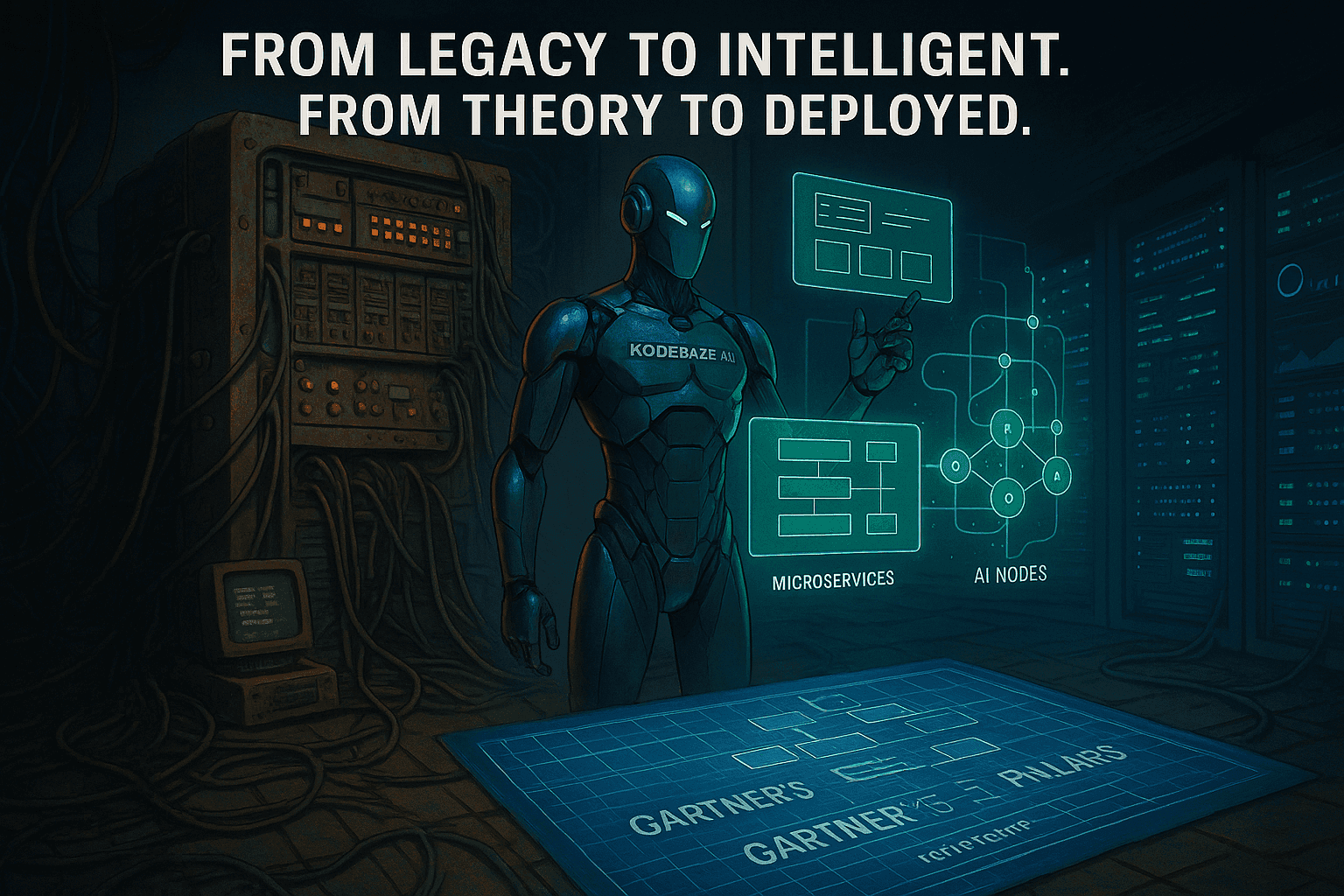
Gartner Wants Intelligent Applications. Here Is How Legacy Systems Get There.

By Claus Villumsen
30 October, 2025
Share this article
Gartner says your legacy system needs to become an intelligent application. Here is what that actually means, and how you get there without a big-bang rewrite.
Gartner published a report in 2025 with a clear message. Legacy applications cannot support the AI capabilities that businesses now need. Not without significant transformation. The level of effort, they said, may be significant in terms of cost and duration.
That sentence lands differently depending on where you sit. If you are a vendor selling transformation services, it sounds like an opportunity. If you are the CTO responsible for a system built in 2001 that still runs your core business, it sounds like a threat.
It is both. The question is how you respond to it.
What does Gartner mean by intelligent applications?
Gartner defines intelligent applications as systems that use AI and machine learning to adapt behavior, predict outcomes, and automate decisions in real-time. These applications require modern architectures with decoupled services, event-driven data flows, and API-first designs that enable continuous learning and autonomous operation beyond traditional rule-based automation.
The term sounds like marketing. It is not. Gartner uses it to describe a specific set of capabilities that modern applications need to have. Adaptive experiences that respond to individual user behavior. Embedded intelligence that makes decisions rather than just presenting data. Autonomous orchestration that handles workflows without constant human intervention. Composable architecture that can be extended without rebuilding. Connected data that flows across systems rather than sitting in silos.
None of these are features you bolt on. They are properties of how the system is built. And most legacy systems were not built this way. They were built to do one thing reliably, in one context, for one set of users. That was the right approach in 2001. It is the wrong architecture for 2026.
The gap between where most legacy systems are and where they need to be is real. The question Gartner raises, but does not fully answer, is how you close it without destroying what you already have.
Why don't big-bang rewrites work for legacy modernization?
Big-bang rewrites fail because they create massive business risk, lose critical undocumented logic, and require shutting down operations during transition. They typically exceed budgets by 200-300%, take years longer than planned, and have failure rates above 70%. The approach ignores that legacy systems contain decades of business knowledge impossible to capture in new specifications.
The standard answer is rewrite. Build a new system with modern architecture, migrate the data, cut over, retire the old one. Clean. Simple. Catastrophically risky.
The reason rewrite projects fail at the rate they do is not technical incompetence. It is a knowledge problem. The legacy system contains decades of business logic. Rules accumulated over years of real-world use. Edge cases discovered through failure. Regulatory requirements encoded in ways nobody documented. When you rewrite from scratch, you do not just replace the technology. You replace the accumulated knowledge of the system. And you do not discover what you lost until something breaks in production.
Gartner acknowledges this. Their recommendation is not wholesale replacement. It is incremental modernization, moving toward intelligent application capabilities in stages, without stopping the business.
That is easier to recommend than to execute. The challenge is knowing how to do it safely.
What does safe legacy system modernization look like?
Safe modernization uses the strangler fig pattern: incrementally extract services from the monolith, expose legacy data through APIs, implement event-driven architecture for real-time needs, and gradually redirect traffic to new components. This maintains business continuity, proves each change before proceeding, and delivers AI capabilities in months rather than years while preserving operational stability.
Before any code changes, you need to understand what you have. Not at the level of "we have a Java monolith with an Oracle database." At the level of every dependency between modules, every implicit business rule encoded in a stored procedure, every piece of logic that exists nowhere except in the code. That understanding is what makes incremental modernization possible. Without it, every change is a guess.
AI has changed the economics of this dramatically. What used to take a team of consultants six months to map manually now takes days. Not because AI understands legacy code the way a human expert does, but because it can process volume that humans cannot. A 750,000-line codebase can be analyzed, categorized, and mapped in a fraction of the time it took five years ago.
Once you have the map, you can move modules one at a time. Extract a capability, rebuild it with modern architecture, sync data back to the legacy system while you validate, then cut over. The old system keeps running throughout. The business does not stop. And because you have characterized the existing behavior before touching anything, you can verify that the new module does exactly what the old one did, before you retire the old one.
That is how legacy systems become intelligent applications. Not in one rewrite. In a series of careful, validated, reversible steps.
How do you apply Gartner's framework to legacy systems in practice?
Implementing Gartner's framework on legacy systems requires creating API layers over existing data, extracting high-value business logic into microservices, adding event streaming for real-time processing, and building MLOps pipelines that consume legacy system outputs. This transforms monoliths into composable architectures that support AI capabilities without requiring complete replacement.
Gartner's intelligent application framework is a useful target. Adaptive experiences, embedded intelligence, autonomous orchestration, composable architecture, connected data. Each of these becomes achievable once you have extracted the relevant capabilities from the legacy system and rebuilt them with modern foundations.
You cannot embed intelligence in a monolith. You can embed it in a well-defined service that does one thing, exposes a clean interface, and can be updated independently. The path from legacy monolith to intelligent application runs through modular, well-understood services. And the path to those services runs through understanding what the monolith actually does, which is where most organizations get stuck.
The organizations that will get to Gartner's intelligent application standard fastest are not the ones that plan the most exhaustively before starting. They are the ones that understand enough to choose the right approach, then move carefully, one module at a time, and let the system teach them what they need to know as they go.
Frequently Asked Questions
What are intelligent applications according to Gartner?
Intelligent applications are software systems that use AI and machine learning to adapt, predict, and automate decisions in real-time. According to Gartner's 2025 framework, these applications require modern architectures with decoupled services, clean data pipelines, and API-first designs that legacy monolithic systems cannot support without transformation.
Why can't legacy systems support AI capabilities without modernization?
Legacy systems lack the architectural flexibility for AI integration because they feature tightly coupled monolithic code, poor data accessibility, absence of APIs, and rigid infrastructure. AI models require real-time data access, microservices architecture, and scalable compute resources that legacy applications were never designed to provide.
How do you modernize legacy applications without a complete rewrite?
Safe modernization uses incremental transformation through the strangler fig pattern: extract business logic into microservices, expose data via APIs, implement event-driven architecture for real-time processing, and gradually replace legacy components while maintaining system stability. This approach reduces risk and allows continuous operation during transformation.
How long does legacy application modernization take?
Legacy modernization timelines vary from 6 months to 3 years depending on system complexity and scope. Incremental approaches deliver initial AI capabilities within 3-6 months by targeting high-value modules first, while complete transformation of enterprise systems typically requires 18-36 months with phased rollouts.
What is the strangler fig pattern for legacy modernization?
The strangler fig pattern is a modernization strategy where new services gradually replace legacy system components without disrupting operations. New functionality is built alongside the old system, traffic is incrementally redirected to modern services, and legacy code is retired only after the replacement is proven stable.
What are the main risks of big-bang legacy system rewrites?
Big-bang rewrites carry catastrophic risks including complete business disruption, loss of undocumented business logic, budget overruns exceeding 200-300%, extended downtime, and project failure rates above 70%. Most organizations that attempt full rewrites experience significant operational damage and many abandon the effort entirely.
How does Gartner's framework apply to legacy system transformation?
Gartner's intelligent application framework requires legacy systems to adopt composable architecture, implement AI-ready data layers, enable real-time processing, and support continuous adaptation. Practical implementation involves API exposure, microservices extraction, event streaming integration, and establishing MLOps pipelines that connect to existing business logic.
What results can companies expect from legacy modernization for AI?
Successfully modernized legacy systems achieve 40-60% faster feature deployment, 3-5x improvement in system scalability, 30-50% reduction in operational costs, and the ability to implement AI capabilities like predictive analytics, intelligent automation, and real-time decision making that drive competitive advantage and revenue growth.
Kodebaze starts every engagement with a full codebase analysis — mapping every dependency, hidden business rule, and undocumented behavior before anything is touched. See how the AI modernization factory works.
See how it works →Related articles
Productivity
AI
Coinbase built a Ruby on Rails monolith that scaled to billions in transactions and then became a liability. The technical debt they accumulated took years to address. Here is what the faster path looks like.

Work
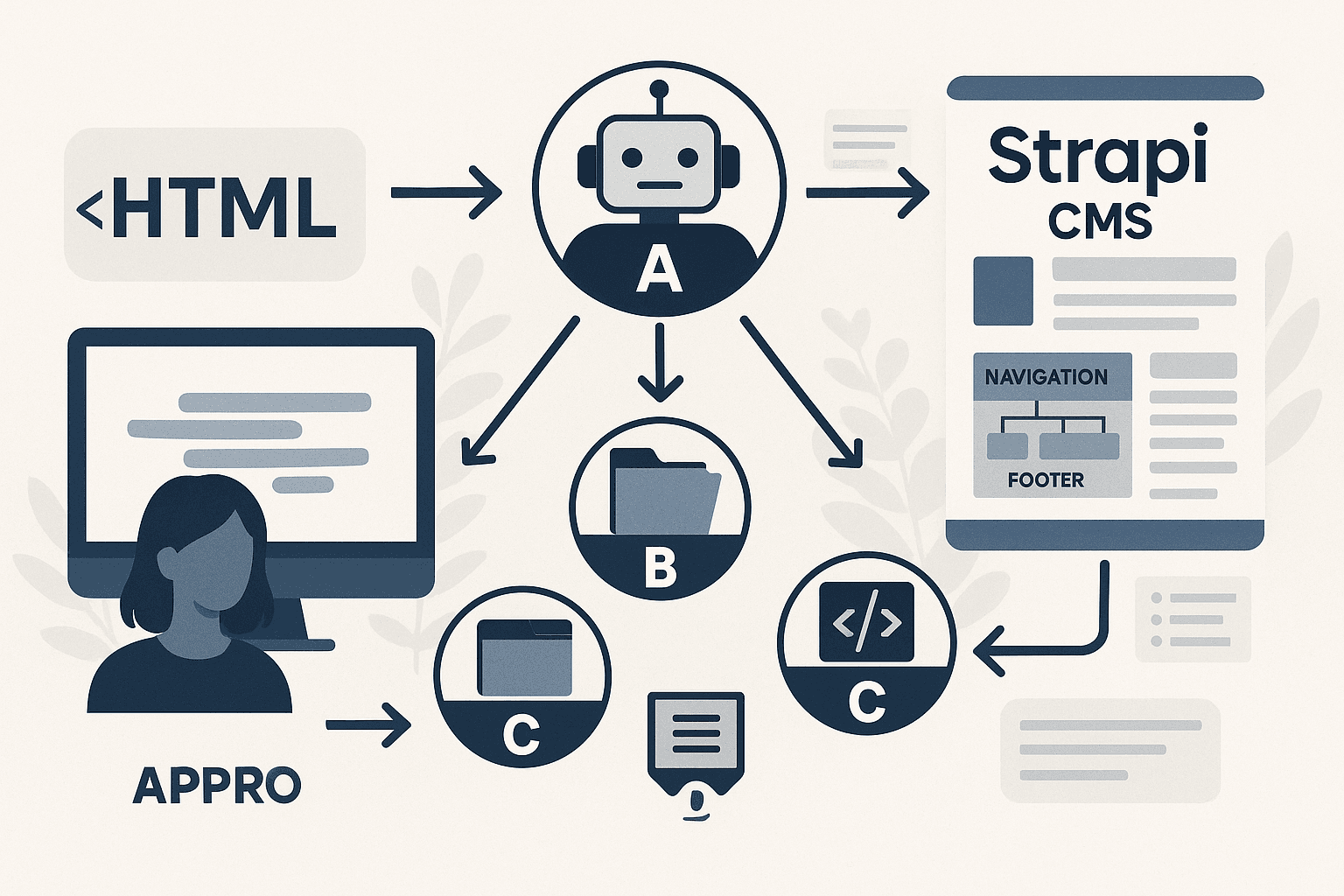
We had a mountain of legacy HTML that needed to become structured Strapi CMS content. Manual conversion would have taken months. We built four AI agents to do it instead. Here is how they work.

Work
Every digital transformation strategy eventually hits the same wall. The legacy system that cannot be modernized fast enough. Here is why that wall exists and what it actually takes to get through it.
AI + Human
AI + Human software Solution
© 2026 Kodebaze. All Rights Reserved.
© 2026 Kodebaze. All Rights Reserved.