
Articles
What Actually Drives Technology Modernization (And Why Security Is Finally Forcing the Issue)

By Claus Villumsen
21 June, 2026
Share this article
Your CISO just walked into your office with another report. Three critical vulnerabilities in systems you can't patch because the vendor stopped supporting them in 2019. The compliance team is asking questions you don't have good answers for. And somewhere in the back of your mind, you know this was always going to happen.
Technology modernization used to be sold as innovation. As competitive advantage. As digital transformation that would revolutionize how the business operates. That's not what's driving it anymore. What's driving it now is fear. The fear that the systems holding your business together are also the ones most likely to bring it down.
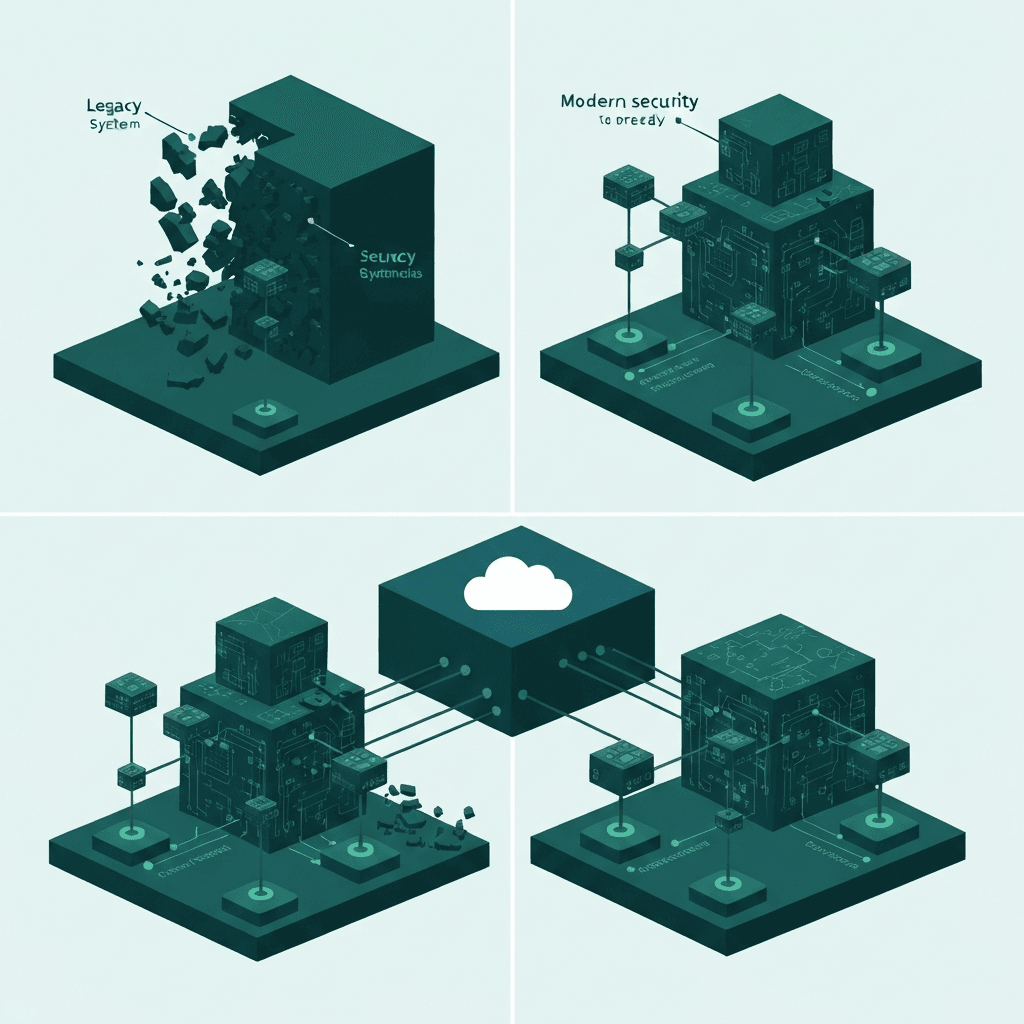
We've analyzed hundreds of modernization initiatives over the past three years. The pattern is unmistakable. **The organizations that move fastest aren't chasing opportunity, they're running from risk.** Security incidents, regulatory pressure, and the mounting cost of operational fragility are doing more to accelerate legacy application modernization than any innovation agenda ever did.
When was the last time you reviewed your technology portfolio not for what it enables, but for what it exposes you to? Not what features it has, but what vulnerabilities it's hiding?
Why are security vulnerabilities accelerating technology modernization decisions?
Security vulnerabilities in unsupported legacy systems create unmanageable risk that can't be mitigated through traditional patching. When vendors end support, organizations face a choice: modernize the application or accept exposure that regulators, insurers, and customers increasingly won't tolerate.
The math here is brutally simple. Legacy systems accumulate vulnerabilities faster than you can remediate them. Not because your security team isn't competent. Because the systems themselves are built on architectures that predate modern security models.
**The average enterprise runs 47 applications that are no longer supported by their vendors.** That's not a typo. Forty-seven applications where a new CVE could drop tomorrow and there's no patch coming. Ever. You can try to isolate them. You can implement compensating controls. You can monitor them more closely. But you can't actually fix them without changing the underlying code.
And the attackers know this. They're specifically targeting legacy systems because the exploit landscape is well-mapped and the defensive options are limited. When a major breach happens, the post-mortem almost always traces back to a system that should have been modernized five years ago.
This is what finally moves modernization from the "nice to have" list to the "we're doing this now" list. Not the CFO's innovation goals. The realization that you're one zero-day away from a very bad month.
How do compliance mandates force technology modernization timelines?
Compliance frameworks increasingly require documented software supply chain security, encryption standards, and audit capabilities that legacy systems can't provide. Regulators aren't accepting "the system is too old" as an excuse anymore, forcing organizations to modernize or face penalties.
Pick your regulatory framework. GDPR. SOC 2. PCI DSS 4.0. DORA in financial services. Every one of them has gotten more prescriptive about the technical controls you need to have in place. And every one of them is harder to satisfy with systems built before those frameworks existed.
Take encryption at rest. Sounds simple. But if your core business application is running on a database from 2012, there's a decent chance it doesn't support the encryption standards current compliance requires. You can't just flip a switch. You need to upgrade the database. Which means upgrading the application tier that talks to it. Which means testing everything that depends on both.
Or take audit logging. Modern compliance frameworks want to know who accessed what data, when, and why. They want immutable logs. They want retention policies. **Your legacy monolith logs to a flat file that gets rotated every week and doesn't capture half the events that matter.**
The compliance team used to work around this. They'd write exception reports. They'd implement manual processes. They'd explain to auditors why the system couldn't do what it needed to do. That's not working anymore. Auditors are less sympathetic. Regulators are less flexible. And the fines for non-compliance have gotten large enough that the business is finally willing to fund the modernization work.
What operational costs make legacy systems too expensive to keep running?
Legacy systems carry hidden costs in specialized talent, manual workarounds, extended deployment cycles, and infrastructure that can't leverage modern cloud economics. When the total cost of ownership exceeds the cost to modernize, the financial case becomes undeniable.
Let's talk about what it actually costs to keep a legacy system alive. Not the license fees. Everyone knows about those. The real costs are in the margins.
You need people who understand COBOL, or PowerBuilder, or whatever framework was popular when the system was built. Those people are expensive. They're hard to hire. And they're usually not interested in maintaining legacy code when they could be building new things somewhere else. So you pay retention bonuses. You live with knowledge silos. You hope the one person who really understands the billing module doesn't retire.
Then there's the infrastructure. Your legacy applications probably can't run in modern cloud environments without significant modification. So you're maintaining on-premise data centers, or running them in IaaS configurations that don't benefit from any of the cost optimizations cloud-native applications get. **You're paying 2026 prices for 2012 architecture.**
And the workarounds. Oh, the workarounds. Every time the business needs something new, you can't just build it into the legacy system. You build an integration. You export data to a modern tool. You create manual processes to bridge the gap. Each workaround adds complexity. Each one adds maintenance burden. Each one is another thing that can break.
Eventually, finance does the math. They add up the real cost. And they realize that modernizing the application, even if it takes two years and significant investment, is cheaper than continuing to operate the legacy system for another five.
Have you actually calculated what it costs to keep your legacy systems running? Not just the obvious expenses, but the opportunity cost of the engineering time spent on maintenance instead of building new capabilities?
What makes cloud migration and architecture modernization necessary now?
Cloud-ready architecture modernization isn't optional anymore because on-premise infrastructure is becoming economically and operationally unsustainable. Data center contracts are expiring, hardware refresh cycles are forcing decisions, and the talent to maintain legacy infrastructure is disappearing.
There's a forcing function happening in infrastructure that most organizations didn't see coming. The economic model that made on-premise data centers viable is collapsing. Hardware vendors are pushing you toward subscriptions. Data center leases are coming up for renewal at prices that don't make sense anymore. And the people who know how to run physical infrastructure are moving to roles where they manage cloud environments instead.
So you look at your options. You can renew the data center lease for another five years. You can buy new hardware to replace the servers that are aging out. You can try to hire infrastructure engineers in a market where everyone wants cloud skills. Or you can finally do what you've been planning to do since 2019 and move to the cloud.
Except you can't just lift and shift your legacy applications. Well, you can. But you shouldn't. **You'll end up paying cloud prices for on-premise architecture, which is the worst of both worlds.** To actually benefit from cloud economics, you need to modernize the applications themselves. You need to break apart monoliths. You need to make them stateless. You need to redesign them to scale horizontally instead of vertically.
That's what's really driving cloud migration. Not the promise of infinite scale or global reach. The reality that your current infrastructure model has an expiration date, and when that date hits, you need to have applications that can run somewhere else.
Where does AI-assisted refactoring fit in security-driven modernization?
AI-powered legacy code modernization tools can accelerate security remediation by identifying vulnerable code patterns, suggesting modern alternatives, and automating portions of refactoring work. But AI can't make architectural decisions or understand business context without human expertise guiding the process.
Let's be clear about what AI actually helps with in modernization work. It's genuinely useful for pattern recognition. You can feed it a legacy codebase and it will identify outdated libraries, flag known vulnerability patterns, and suggest modern equivalents. That work used to take senior engineers weeks. Now it takes hours.
AI can also help with the tedious parts of refactoring. Converting deprecated API calls to current versions. Updating authentication mechanisms to modern standards. Identifying where business logic is tangled with presentation code and suggesting separation points. These are mechanical tasks that benefit from automation.
**But AI can't tell you which modernization approach actually makes sense for your business.** It can't decide whether to refactor in place or rebuild from scratch. It can't evaluate whether a microservices architecture is worth the operational complexity for your team size and use case. It can't look at your legacy system and understand which parts are genuinely business-critical and which parts are just accumulated cruft.
The organizations getting value from AI in modernization work are using it as a tool, not a strategy. They're using AI to speed up analysis and automate grunt work. But they're keeping humans in the loop for architectural decisions, security trade-offs, and business priority calls.
Where AI falls short is context. It doesn't know that the weird workaround in the payment processing code exists because of a regulatory requirement from 2015. It doesn't know that the seemingly redundant validation logic is there because the upstream system sometimes sends malformed data. It will suggest removing code that looks unnecessary but is actually load-bearing.
The smart play is to use AI to accelerate the work your team already knows how to do, not to replace the judgment that comes from understanding the system's history and business context.
How should organizations prioritize modernization when security forces the timeline?
Security-driven modernization requires risk-based prioritization that addresses the most exposed systems first while building toward sustainable architecture. Start with applications that process sensitive data, have known vulnerabilities, or sit in compliance-critical paths, then expand systematically.
When security is forcing your hand, you don't have the luxury of a five-year roadmap. You need to make decisions fast about what gets fixed first. That means triage.
Start with exposure. Which systems handle personally identifiable information? Which ones process payment data? Which ones are internet-facing? Those go to the top of the list. Not because they're the most important to the business. Because they're the most likely to get you in regulatory trouble or end up in a breach disclosure.
Then look at dependency chains. Some legacy systems are isolated. Others are deeply embedded in critical business processes. **A vulnerability in your order management system is more urgent than one in your internal expense reporting tool.** Prioritize based on blast radius.
Don't try to boil the ocean. Pick two or three applications to modernize in the first wave. Do them right. Learn from them. Build the internal expertise and tooling. Then scale the approach to the next tier.
And be honest about what "modernization" means for each system. Some applications need full rewrites. Others just need to be moved off unsupported platforms. Some need security patches and updated dependencies but the core architecture is fine. Match the intervention to the risk.
If your board asked you tomorrow which legacy systems pose the greatest security risk to the organization, could you answer with confidence? And if you can answer it, what are you doing about it?
Frequently Asked Questions
What is technology modernization in the context of security?
Technology modernization for security means updating legacy systems that have exploitable vulnerabilities, lack modern security controls, or run on unsupported platforms. It involves refactoring applications to use current security standards, moving to supported technology stacks, and implementing architecture patterns that reduce attack surface and improve resilience.
How long does security-driven modernization typically take?
A single critical application modernization usually takes 6 to 18 months depending on complexity, team size, and whether you're refactoring or rebuilding. Portfolio-wide modernization across multiple legacy systems typically spans 2 to 4 years with phased rollouts. Timeline depends heavily on how much technical debt exists and whether you have clear architectural targets.
Should we modernize in-house or use external modernization services?
Most organizations need a hybrid approach. Your team knows the business logic and system quirks that outsiders won't catch. External specialists bring modernization methodology, tooling, and experience with similar migrations. The best results come from partnerships where external expertise accelerates the work but your team maintains ownership and builds internal capability.
What's the ROI of modernizing legacy systems for security?
The ROI calculation includes avoided costs from potential breaches, reduced compliance risk, lower infrastructure and maintenance costs, and improved operational efficiency. Organizations typically see 30-40% reduction in maintenance costs within two years, significant decreases in security incident response time, and elimination of expensive specialized legacy talent requirements. The hard ROI is often less important than the risk reduction.
Can AI tools fully automate legacy application modernization?
No. AI-powered tools can automate code analysis, vulnerability detection, and portions of refactoring work, but they can't make architectural decisions, understand business context, or evaluate security trade-offs. AI accelerates modernization by handling repetitive analysis and transformation tasks, but human expertise is essential for strategy, design, and validating that automated changes preserve business logic correctly.
What are the biggest risks in security-focused modernization projects?
The primary risks are introducing new vulnerabilities during refactoring, breaking existing business logic that wasn't well documented, and scope creep when teams try to add features while modernizing. Other risks include underestimating the complexity of data migration, inadequate testing of edge cases, and losing institutional knowledge if key people leave mid-project. Disciplined scope management and comprehensive testing are critical.
How do we maintain business continuity during modernization?
Use strangler fig patterns to gradually replace legacy system components while keeping the old system running. Implement feature flags to control rollout of modernized modules. Run old and new systems in parallel during transition periods with careful data synchronization. Plan rollback procedures for every deployment. Never do big-bang cutovers for mission-critical systems. Incremental migration with validation gates is the only safe approach.
What compliance frameworks most commonly drive modernization decisions?
PCI DSS 4.0 for payment processing, GDPR for data privacy in EU markets, SOC 2 for SaaS vendors, HIPAA for healthcare, and DORA for financial services are the most common forcing functions. These frameworks increasingly require specific technical controls around encryption, access logging, data retention, and software supply chain security that legacy systems can't provide without substantial modification or replacement.
Kodebaze helps organizations modernize legacy applications with AI-assisted analysis and refactoring that addresses security vulnerabilities while preserving business logic.
See how it works →Related articles
Legacy Modernization
AI
A cloud readiness assessment tells you what you actually have before you move it. Here is how to run one that gives you real answers, not false confidence.


Legacy Modernization
AI
A practical guide to application portfolio assessment and modernization roadmap planning - so you know what to fix, what to retire, and in what order.
Legacy Modernization
AI
Regression-safe AI refactoring lets teams modernize legacy codebases without breaking existing behaviour. Here is what auditable, low-risk modernization actually looks like in practice.
AI + Human
AI + Human software Solution
© 2026 Kodebaze. All Rights Reserved.
© 2026 Kodebaze. All Rights Reserved.